
- June 9, 2026
- Posted by: accsolms
- Category: Uncategorized
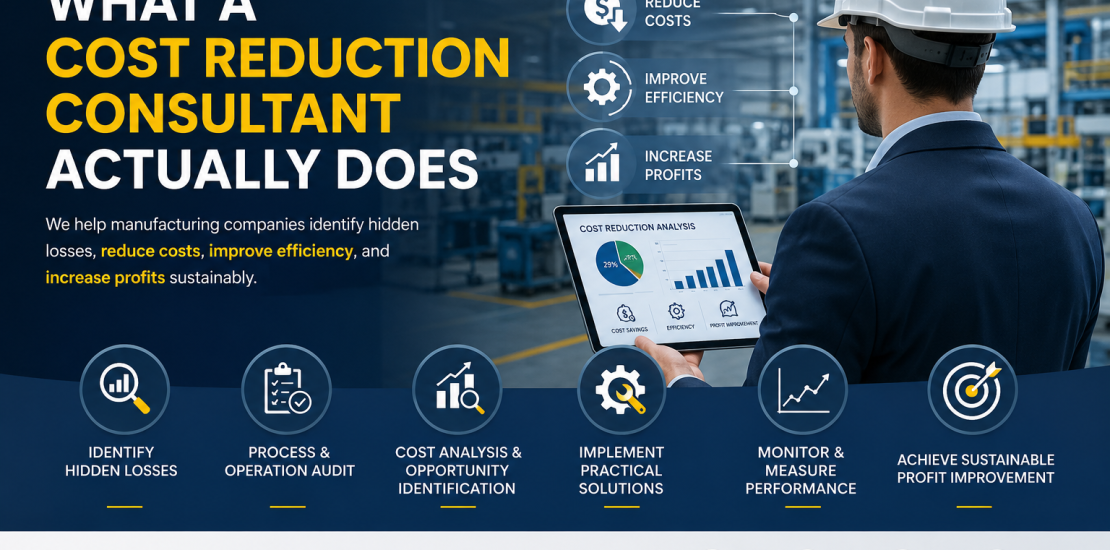
In today’s very competitive manufacturing environment, controlling costs is just as important as growing sales, for real.
A lot of factory owners think that profit growth only comes from pulling in more orders, but the truth is sometimes way different. There are hidden inefficiencies, process gaps, inventory losses, excess manpower costs, and plain operational waste that can keep quietly draining profitability even while production volumes look strong.
That’s where a manufacturing cost reduction consultant really comes in. A consultant doesn’t only point out what expenses exist.
The main idea is to hunt down unseen profit leaks, improve operational efficiency, and make sure the business can move toward sustainable growth without lowering quality or stepping on customer satisfaction.
At Accsol, we’ve supported manufacturing companies dealing with all sorts of operational and financial headaches.
In many situations the owner already felt that profits were lower than expected, but they simply couldn’t locate the exact cause.
With audits, process studies, and hands-on operational reviews, we were able to uncover the root reasons and then roll out workable solutions. The result was measurable improvement, not just theory.
Why Manufacturing Companies Lose Profit
Many business owners focus a lot on production targets, but they kind of ignore the small inefficiencies that build up, you know, over time. These less obvious issues quietly trim margins, and they can also steer long-term growth in the wrong direction.
Common challenges tend to show up like this:
Too much raw material consumption
High costs to carry inventory
Production bottlenecks
Weak process controls
Rework and rejection losses
Unexpected machine downtime
Not so great purchasing practices
Low operational visibility
Bad cost monitoring systems
Soft internal controls
A skilled manufacturing cost reduction consultant digs into these areas, really in detail, and then pinpoints chances for improvement.
What Does a Manufacturing Cost Reduction Consultant Actually Do?
A manufacturing cost reduction consultant does a thorough look at the organization’s operations, its process flows, and how the financial performance actually comes out. The goal is not only cutting costs , it’s also about building a sturdier and more profitable business model.
Usually, the consultant will review:
Production Processes
Manufacturing processes get examined to spot delays, inefficiencies, and things that shouldn’t be happening at all. Even those slight tweaks to workflow, they can turn into meaningful savings once they stack together.
Key areas include:
Production cycle time
How resources get used
Machine efficiency
Material flow
Process standardization
Waste generation
When inefficiencies get removed, productivity tends to climb without needing big capital investments.
Inventory Management
Inventory is often one of the biggest money holds for manufacturing companies. When inventory is handled poorly, it can choke working capital and push storage costs up.
A manufacturing cost reduction consultant typically evaluates the following:
Stock levels
Inventory turnover
Slow-moving inventory
Dead stock
Purchase planning systems
Cutting excess inventory frees cash flow, and it directly supports profitability too.
Purchase and Procurement Audits
Lots of manufacturers end up losing money because buying decisions are not checked regularly , or at least not in a consistent way.
Procurement problems that commonly appear:
Vendor dependency
Prices that aren’t competitive
Unnecessary purchases
Too much safety stock
No real purchase controls
By tightening procurement practices, businesses often unlock solid cost savings while still keeping the supply chain stable and dependable.
The Connection Between Cost Reduction and Factory Profit Improvement
Many business owners think cost reduction is basically cutting expenses aggressively, but professional cost reduction is more like efficiency adjusting, not just cheapening things. So the aim is factory profit improvement through smarter operations and better day-to-day choices.
For example:
Cutting production waste boosts margins.
Making machine utilization better pushes more output.
Improving inventory handling strengthens cash flow.
Streamlining processes removes labor inefficiencies without messing up quality.
These kinds of changes support factory profit improvement directly, while keeping product quality stable and avoiding negative impacts on employee performance
Preliminary Studies: Finding Hidden Problems
One of the most valuable services Accsol provides is the preliminary study. Before suggesting solutions, it helps to know the actual condition, not the guess version.
This preliminary study usually includes things like the following:
Plant observations
Departmental reviews
Process evaluations
Cost structure analysis
Operational assessments
Management discussions
With this method, problems that never show up clearly in financial reports can still come into view.
In several manufacturing facilities, our preliminary studies have uncovered hidden operational losses that had been quietly sitting there for years, without management realizing.
Internal Audits That Drive Results
Internal audits are sometimes treated like purely compliance chores. But operational and process audits can become real profitability improvement tools. When a manufacturing cost reduction consultant runs internal audits, the focus often includes:
Process compliance
Resource utilization
Department performance
Operational controls
Risk exposure
Cost management effectiveness
Then, when the findings are turned into workable improvements, businesses usually see stronger operational performance and better financial outcomes.
Common Manufacturing Problems We Encounter
Over time, Accsol has seen repeated patterns across multiple manufacturing sectors.
High Material Consumption
Raw material usage often ends up higher than planned because monitoring is weak or process variations get loose.
Typical fixes:
Consumption tracking
Process standardization
Production monitoring systems
Excess Inventory
Many factories keep stock levels well past what’s actually needed. Common solutions:
Inventory classification
Reorder point optimization
Demand-based planning
Low Productivity
People might be busy, but inefficient processes lower output.
Solutions often include:
Workflow redesign
Performance measurement
Bottleneck elimination
Poor Cost Visibility
Owners sometimes know the revenue picture, yet the cost picture stays blurry.
Common solutions:
Cost monitoring systems
Department-wise reporting
Operational KPI tracking
Taken together, these improvements support long-term factory profit improvement and help decision-making become more grounded.
Why Experience Matters
Cost reduction isn’t something you can do with generic templates.
Each manufacturing company is different in areas like the following:
Products
Processes
Workforce structures
Production methods
Cost drivers
An experienced manufacturing cost reduction consultant knows how to find improvements that actually fit the company’s operational reality. At Accsol, recommendations are based on direct observations, audits, and data analysis, instead of assumptions. That practical style usually makes improvements realistic and also easier to deliver.
Benefits of Hiring a Manufacturing Cost Reduction Consultant
When organizations hire a manufacturing cost reduction consultant, benefits often show up, like:
Increased Profitability
Hidden operational losses shrink, and margins improve.
Better Productivity
Optimized workflows raise output using the same resources.
Improved Inventory Control
Lower inventory levels support cash flow and also reduce carrying costs.
Stronger Internal Controls
Operational risks are detected and handled more effectively.
Data-Driven Decisions
Management gets better visibility into actual performance.
Sustainable Growth
Efficiency improvements build a base for long-term expansion.
How Accsol Helps Manufacturing Companies
At Accsol, our process starts with understanding the real challenges the organization is facing.
Our services include:
Manufacturing process audits
Internal audits
Preliminary studies
Operational reviews
Cost analysis
Inventory audits
Purchase audits
Productivity improvement assessments
Profitability enhancement programs
Instead of tossing out generic suggestions, we focus on locating the root causes, then implementing practical solutions.
Many businesses come to us because they can feel profitability is being affected but can’t pinpoint the reason. Through structured reviews and detailed assessments, we help uncover the hidden issues and turn them into clear action plans.
As a trusted manufacturing cost reduction consultant, our goal is to help organizations improve efficiency, reduce waste, strengthen controls, and increase profitability.
Conclusion
Manufacturing companies are under rising pressure to control costs while still maintaining quality and productivity. Hidden inefficiencies can hurt profitability a lot, even when sales are still strong.
A professional manufacturing cost reduction consultant helps uncover these hidden losses, improves operational performance, and supports sustainable business improvements. Whether the issue involves inventory management, production inefficiencies, procurement problems, or operational controls, the right approach can shift performance and deliver measurable results.
For businesses aiming at long-term factory profit improvement, operational audits, preliminary studies, and process optimization create strong opportunities to uncover hidden savings and unlock more profitability. At Accsol, we believe every manufacturing problem has a practical solution. Through structured audits, detailed analysis, and operational expertise, we help manufacturing companies convert challenges into opportunities and build stronger, more profitable operations.