
- May 18, 2026
- Posted by: accsolms
- Category: Uncategorized
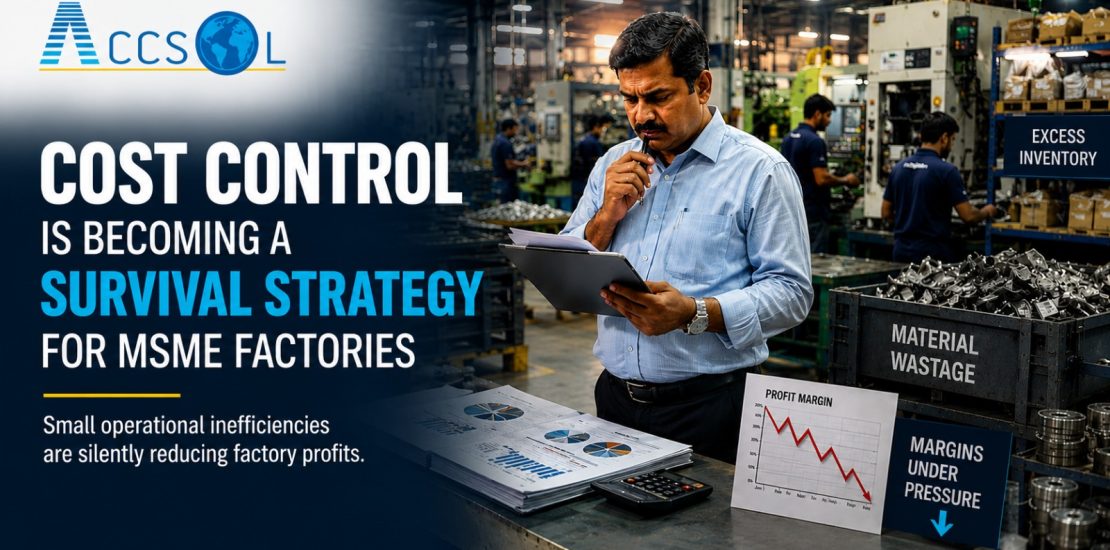
Cost Control Strategies for Small Factories Struggling with Margins
Many small factories today are working harder than ever — yet profit margins continue shrinking.
Orders are coming in.
Machines are running.
Employees are working overtime, but in the end of the month, a lot of factory owners still get financial pressure, like somehow it never really goes away.
Why?
Because most manufacturing losses don’t come from one big blunder, not usually.
They more often come from small daily operational inefficiencies, that quietly bleed profits over time, and nobody notices right away.
Across Tamil Nadu’s MSME manufacturing sector — yes, including textile units, pump manufacturers, fabrication workshops, automobile component factories and engineering industries — the rising operational costs are turning into a real headache.
Raw material prices keep shifting, constantly.
Labour shortages add even more weight to production targets.
Power costs keep climbing.
Customers push back hard on pricing, even when the quote is fair.
And competition gets more intense every year, no mercy.
In this situation, factories that can’t rein in operational inefficiencies usually find it hard to keep healthy margins, slowly but surely.
At ACCSOL, we believe one important truth:
Cost Control Is Not About Cutting Expenses Randomly
True cost control comes from improving operational efficiency.
Because in most factories, hidden losses happen through:
- Production inefficiencies
- Material wastage
- Excess inventory
- Machine downtime
- Rework and rejection
- Poor planning systems
- Weak process monitoring
- Uncontrolled purchasing
- Delayed dispatches
- Lack of SOPs
- Labour productivity gaps
Many manufacturers focus heavily on increasing sales.
But sustainable profitability often starts by fixing internal process inefficiencies first.
1. Reduce Hidden Production Wastage
One of the biggest profit leakages in manufacturing happens through unnoticed daily wastage.
In many factories, losses occur due to:
- Excess raw material consumption
- Incorrect cutting or machining
- Improper production handling
- Repeated rework
- Production delays
- Scrap generation
- Poor quality monitoring
Individually, these issues may appear small.
But collectively, they can reduce profitability significantly over a month or year.
For example, in textile and fabrication industries, even a small percentage of excess material usage can result in lakhs of rupees in annual losses.
Factories that monitor wastage department-wise usually gain stronger operational control and healthier margins.
2. Standardize Operations Using SOPs
Many MSMEs still operate based on “staff experience” instead of standardized systems.
This creates operational dependency on individuals.
When experienced employees leave, factories often face:
- Production inconsistency
- Quality variation
- Training difficulties
- Communication gaps
- Repeated operational errors
- Lower productivity
Standard Operating Procedures (SOPs) help factories create consistency across operations.
With proper SOP implementation:
- Errors reduce
- Productivity improves
- Labour management becomes easier
- Quality becomes more stable
- Monitoring systems improve
- Operational confusion decreases
For growing factories, SOPs are not optional anymore.
They are essential for long-term operational stability and cost control.
3. Improve Inventory Control Systems
Poor inventory management is one of the largest hidden profit killers in manufacturing.
Many factories unknowingly block huge amounts of working capital through uncontrolled stock management.
Common inventory-related problems include:
- Excess stock accumulation
- Duplicate material purchases
- Slow-moving inventory
- Material shortages during production
- Untracked consumption
- Emergency purchasing at higher rates
In many MSMEs, production teams still face shortages even when large quantities of stock are already available inside the factory.
The problem is not always lack of inventory.
The problem is lack of inventory visibility and control.
Strong inventory systems help factories:
- Improve cash flow
- Reduce unnecessary purchases
- Prevent production interruptions
- Monitor material consumption
- Improve planning accuracy
- Reduce working capital pressure
4. Monitor Department-Wise Cost Leakage
One major mistake many small factories make is reviewing expenses only at the company level.
But operational losses happen process by process.
For example:
- Production inefficiency increases labour cost
- Quality rejection increases material loss
- Maintenance delays affect dispatch timelines
- Poor procurement planning increases purchase cost
- Weak supervision reduces accountability
Without department-level monitoring, management cannot identify the true source of margin erosion.
Factories need measurable operational KPIs such as:
- Production efficiency
- Rejection percentage
- Machine utilization
- Labour productivity
- Inventory turnover
- Delivery performance
- Material variance
What gets measured gets controlled.
And factories with strong monitoring systems usually make faster and more profitable operational decisions.
5. Reduce Machine Downtime
Machine downtime affects profitability far beyond repair expenses.
It creates chain reactions across operations.
Downtime often leads to:
- Production delays
- Labour idle time
- Delivery failures
- Overtime expenses
- Customer dissatisfaction
- Lower production efficiency
Many MSMEs still operate with reactive maintenance systems where machines are repaired only after breakdowns occur.
But preventive maintenance systems help reduce unexpected stoppages significantly.
Even basic maintenance planning and machine monitoring can improve operational continuity and reduce avoidable costs.
6. Improve Production Planning
Weak production planning creates operational pressure across multiple departments.
Poor planning can result in:
- Material shortages
- Excess overtime
- Delivery delays
- Idle machines
- Workflow imbalance
- Labour inefficiency
- Customer complaints
Strong production planning improves:
- Capacity utilization
- Workflow management
- Labour allocation
- Inventory coordination
- Dispatch performance
- Production efficiency
Factories with structured planning systems generally operate with stronger margins and fewer operational disruptions.
7. Strengthen Internal Monitoring Systems
Many factory owners personally solve every operational issue because internal monitoring systems are weak.
This creates dependency on management involvement for daily operations.
As factories grow, this becomes difficult to sustain.
Strong internal monitoring systems improve accountability and operational discipline.
This includes:
- Daily reporting structures
- Process tracking systems
- Department-wise accountability
- Performance monitoring
- Escalation procedures
- Workflow visibility
Operational visibility is one of the most important foundations of long-term profitability.
8. Use Operational Data for Better Decision-Making
Many MSMEs still rely heavily on assumptions instead of operational data.
But modern manufacturing requires visibility and measurement.
Even simple Excel dashboards can help factories monitor:
- Daily production performance
- Material consumption
- Labour productivity
- Cost trends
- Rejection rates
- Delivery performance
- Inventory movement
Data-driven factories identify problems faster and make better operational decisions.
And better decisions lead to stronger profit margins.
Cost Cutting Alone Is Not the Solution
Many businesses attempt random cost cutting measures such as:
- Reducing manpower
- Cutting maintenance budgets
- Lowering quality checks
- Delaying operational spending
But uncontrolled cost cutting often creates bigger operational problems later.
The goal should not be:
“How do we spend less?”
The better question is:
“How do we operate more efficiently?”
That is where sustainable profitability comes from.
How ACCSOL Helps Manufacturing Businesses
At ACCSOL Management Services Pvt. Ltd., we help MSME manufacturers identify hidden operational inefficiencies through our Business Process Management (BPM) approach.
We focus on:
- Process analysis
- Workflow optimization
- SOP development
- Operational audits
- Inventory control systems
- KPI monitoring
- Cost leakage identification
- Productivity improvement
- Department coordination
- Operational standardization
Our objective is simple:
Help factories improve profitability by strengthening internal business processes.
Because in manufacturing:
Better systems create better margins.
And many factories already have enough business to grow profitably — they simply need stronger operational control systems.
Final Thoughts
Most factories do not struggle because of lack of demand alone.
They struggle because profits slowly leak through unmanaged operational inefficiencies.
The good news is:
Even small process improvements can create major financial impact over time.
Factories that focus on:
- Process discipline
- Operational monitoring
- Standardization
- Productivity improvement
- Inventory control
- Workflow efficiency
usually build stronger and more stable profit margins — even during difficult market conditions.
Want to Identify Hidden Profit Leakage in Your Factory?
ACCSOL helps MSME manufacturers improve profitability through:
- Business Process Management (BPM)
- Operational audits
- SOP implementation
- Workflow optimization
- Inventory control systems
- KPI-based monitoring structures
If your factory is struggling with:
- Rising operational costs
- Low productivity
- Uncontrolled wastage
- Weak monitoring systems
- Shrinking margins
- Process inefficiencies
our team can help identify the operational gaps affecting profitability.
ACCSOL Management Services Pvt. Ltd.
Optimising Processes. Maximising Profits.