
- February 11, 2026
- Posted by: accsolms
- Category: Uncategorized
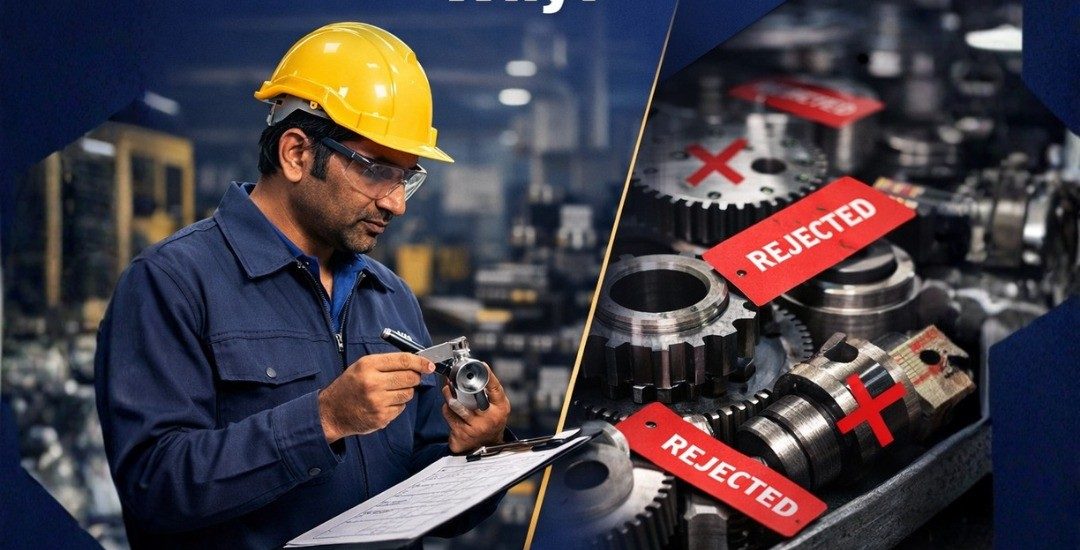
Why Increasing Inspection Does Not Reduce Rejection in Manufacturing
The factory operators in the current industrial landscape think that more inspection teams and additional quality control points will lead to less product rejections.
The situation develops in a way that completely opposes their expectations.
The organization experienced rejection rate problems which persisted despite their efforts to increase staff for inspections and build more quality control stations and strengthen their final inspection process.
If you are struggling with high rejection levels, the problem is not inspection.
The problem is the system. True manufacturing rejection reduction in Coimbatore Tamilnadu does not come from checking defects at the end.
It comes from eliminating the causes at the beginning.
With more than 15+ years of experience, we have seen this pattern repeatedly across industries in Coimbatore—automotive components, textile units, foundries, pump manufacturing, engineering industries, and MSMEs.
Companies increase inspection strength but fail to improve process stability. That is why rejection never comes down permanently.
The Big Myth: “More Inspection Means Less Rejection”
Inspection only identifies defects. It does not prevent them.
We will examine a straightforward case.
The machining process produces 100 defective parts daily which means that inspection should detect all 100 defects. Do you prevent the defects from happening?
The answer is no. The defects are being filtered out by you.
This is where most manufacturers in Coimbatore go wrong. Instead of focusing on root cause elimination, they focus on detection. Detection adds cost. Prevention adds profit.
True manufacturing rejection reduction in Coimbatore Tamilnadu is achieved only when the process is controlled, not when the output is inspected.
Why Rejection Continues Even After Increasing Inspection
1. Process Variation Is Not Controlled
Machines may be running without standard parameter control.
Operators may be adjusting settings based on experience instead of documented SOPs.
Without statistical monitoring, variation increases silently.
Inspection cannot fix variation—it only catches its result.
2. Lack of Root Cause Analysis
Many companies conduct superficial analysis. Instead of using structured problem-solving methods like 5 Why, Fishbone, or Process Mapping, they rely on assumptions.
Real manufacturing rejection reduction in Coimbatore Tamilnadu requires structured root cause elimination.
3. No Process Ownership
The exclusive responsibility of the inspection department to handle quality control leads to production teams losing their engagement.
The process needs quality to be established from its beginning instead of checking it during final assessment.
4. Firefighting Culture
Daily rejection meetings often focus on yesterday’s problems rather than system improvement. Without preventive action plans, the same defects repeat.
5. Poor Process Design
If the process itself is unstable, no level of inspection can reduce rejection. System redesign is required, not just more checking.
The Real Solution: Process Control Over Inspection Control
- The manufacturing companies which achieve the highest success in Coimbatore successfully apply one fundamental principle.
- The process of quality creation must begin from the production stage instead of waiting for product inspection.
- The intelligent companies choose to spend their resources on Standard Operating Procedures (SOPs) instead of increasing their inspection staff.
This is where expert intervention becomes critical.
As experienced business process management consultants in Coimbatore, we focus on transforming systems—not just suggesting surface-level changes.
How Experts Reduce Rejection Permanently
Over the past 15+ years, we have helped manufacturing units across Coimbatore and Tamil Nadu reduce rejection rates by 20% to 60% through structured methodologies.
Here is how professional manufacturing rejection reduction in Coimbatore Tamilnadu is actually implemented:
Step 1: Process Audit
We study the entire manufacturing flow—from raw material to dispatch. We identify hidden leakages where defects originate.
Step 2 : The organization gathers information about product rejections to divide defects into different categories which help them find the most important defects through their use of Pareto analysis.
Step 3 : The organization adopts permanent solutions for process problems through process redesign instead of using temporary solutions which would require ongoing maintenance.
Step 4: Control Mechanism Implementation
We introduce measurable control systems so defects do not reappear.
Step 5: Workforce Alignment
We train operators and supervisors to maintain process discipline.
This systematic approach ensures long-term manufacturing rejection reduction in Coimbatore Tamilnadu, not just short-term improvement.
Why Choosing the Right Consultant Matters
Many industries attempt to solve rejection internally without structured expertise. Unfortunately, internal teams are often too close to the problem to see systemic gaps.
The right business process management consultants in coimbatore bring:
- External, unbiased evaluation
- Industry benchmarking knowledge
- Proven frameworks
- Measurable ROI-focused strategies
- Long-term sustainability planning
With 15+ years of field experience, we are proud to be recognized among the first and leading experts specializing in rejection reduction and business process improvement in Coimbatore, Tamil Nadu.
Financial Impact of High Rejection
Many business owners underestimate the cost of rejection. It is not just scrap cost.
Rejection leads to:
- Raw material loss
- Machine time waste
- Labour inefficiency
- Rework cost
- Delivery delays
- Customer dissatisfaction
- Loss of future business
If your rejection rate is even 5%, your hidden loss may be 15–20% of operational cost due to indirect impacts.
Professional manufacturing rejection reduction in Coimbatore Tamilnadu can significantly increase profit margins without increasing sales. Reducing waste is the fastest way to improve bottom-line performance.
Case-Based Insights from Coimbatore Industries
In one engineering unit, rejection remained at 8% despite adding two inspectors. After process analysis, we found inconsistent coolant concentration was causing dimensional variation. Once controlled through process standardization, rejection dropped to 3% within three months—without increasing inspection.
In a pump manufacturing unit, improper fixture alignment caused repeated bore mismatch. Instead of increasing inspection, we redesigned the fixture validation system. Rejection reduced by 40%.
These improvements were achieved through structured intervention by experienced business process management consultants in coimbatore, not by hiring more quality checkers.
Why Inspection-Heavy Models Fail in the Long Run
Inspection-heavy systems:
- Increase manpower cost
- Slow down production
- Create dependency on detection
- Reduce accountability in operations
- Fail to address root causes
The city of Coimbatore in Tamilnadu needs process-driven leadership to achieve its goal of long-term manufacturing rejection reduction because inspection-based methods fail to provide effective solutions.
Are You Solving the Right Problem?
If your strategy is:
- Add more inspectors
- Increase final checking
- Conduct daily rejection meetings
- Blame operators
Handling the symptoms, not the cause. But the main thing to wonder is this:
Are your processes stable?
Are your controls measurable?
Are your teams trained systematically?
Is your rejection data analyzed scientifically?
If not, inspection will never reduce rejection permanently.
Why We Are the Right Choice in Coimbatore
The period from 15 years of our manufacturing consulting work we have dedicated our services to process improvement and rejection reduction work. Our structured methodology and data-driven approach together with our deep understanding of Coimbatore’s industrial ecosystem make our company a reliable partner for manufacturing transformation projects.
The manufacturing rejection reduction experts in Coimbatore Tamilnadu have recognized our company as a leading organization which helps industrial clients achieve proactive process excellence through our services.
If you are searching for reliable business process management consultants in coimbatore, your search ends here. The difference between temporary correction and permanent improvement lies in expert intervention.
A Process Perspective for Tamil Nadu Manufacturers with ₹50 Crore+ Turnover
The manufacturing facilities in Tamil Nadu face their most difficult operational issue because of their ongoing battle with product rejections. The rejection rates at the facility have not improved despite our continuous improvement efforts which included hiring more inspection staff and establishing extra quality control points.
“We have increased inspection. Why are rejections still not coming down?”
The answer lies in understanding the difference between inspection and process control.
Inspection Finds Defects — It Does Not Prevent Them
Inspection is a detection mechanism.
It helps identify defective output after the defect has already occurred.
In contrast, rejection reduction requires defect prevention, which can only be achieved through stable and controlled processes.
When inspection is increased without improving underlying processes, manufacturers experience:
- Higher quality costs
- Increased manpower expenses
- Slower throughput
- No meaningful reduction in rejection
For ₹50 crore+ manufacturing organisations, this approach becomes unsustainable over time.
Why Rejection Persists Despite Heavy Inspection
From on-ground observations across engineering, foundry, pump, textile, and auto-component units in Tamil Nadu, rejection persists due to process-related causes, not inspection gaps.
Some of the most common reasons include:
- Process Variations Across Shifts
Different operators, different methods, and inconsistent adherence to standards lead to variation. Inspection may catch defects, but it cannot correct variation at source.
- Inconsistent Machine Settings
Lack of standardised machine parameters results in output inconsistency, especially in multi-shift operations.
- Weak Production–Quality Coordination
Quality teams often operate independently of production. Feedback loops are slow, reactive, or informal.
- Unclear Work Instructions
Operators rely on experience instead of documented standards. This makes quality dependent on individuals rather than systems.
- Rework and Internal Rejection Normalised
Over time, internal rejection becomes “part of the process” instead of a signal for corrective action.
The Hidden Cost of Inspection-Driven Quality
Increasing inspection creates a false sense of control while quietly increasing costs.
For larger manufacturing units, this typically results in:
- Rising cost per unit
- Increased quality manpower without ROI
- Higher work-in-progress (WIP)
- Delays in dispatch
- Pressure on margins despite stable sales
Inspection-driven quality systems often focus on symptoms, not root causes.
Why Process Control Is the Only Sustainable Solution
Rejection reduces consistently only when quality is built into the process, not inspected at the end.
Process control focuses on:
- Preventing defects at source
- Reducing variation
- Standardising work
- Making output predictable
This approach is especially critical for manufacturers operating at scale, where small inefficiencies multiply into large losses.
Key Process-Focused Actions That Reduce Rejection
Based on proven operational principles, the following actions consistently help reduce rejection:
- Map Critical Processes End-to-End
Understand how work actually happens on the shop floor — not how it is assumed to happen.
- Identify Process Loss Points
Track where variation, delays, rework, and errors originate at an operational level.
- Standardise Work Across Shifts
Ensure methods, parameters, and responsibilities are consistent regardless of operator or shift.
- Strengthen Feedback Loops
Quality data must flow quickly back to production for immediate corrective action.
- Measure Process Capability
Move beyond output inspection and start monitoring process performance indicators.
Inspection Has a Role — But Not the One Most Think
Inspection is still important.
But its role should be verification, not control.
In mature manufacturing systems:
- Inspection validates process output
- Processes themselves control quality
- Rejection trends trigger process review, not manpower increase
This shift in mindset is critical for Tamil Nadu manufacturers aiming for scalable, profitable growth.
Why This Matters More for ₹50 Crore+ Manufacturers
As manufacturing organisations grow, complexity increases:
- More products
- More machines
- More people
- More customers
In such environments, inspection-heavy models break down quickly.
Only process-driven systems can:
- Maintain consistency
- Reduce dependence on individuals
- Control cost per unit
- Sustain quality at scale
Final Thoughts
If rejection is not reducing despite increased inspection, the issue is not effort — it is process design and discipline.
Inspection can identify problems.
Only strong processes can eliminate them.
Manufacturers who shift their focus from “checking more” to “controlling better” see long-term, sustainable improvements in quality, cost, and delivery performance.