
- January 10, 2026
- Posted by: accsolms
- Category: Uncategorized
Why Inspection Doesn’t Reduce Rejection — Process Control Does
In manufacturing environments across Tamil Nadu, rejection is one of the most discussed yet least understood performance indicators — especially in the context of business process management in India.
Most factories measure rejection as a quality metric.
Many factories report rejection in reviews and dashboards.
But very few factories actually control rejection through structured business process management in India–focused manufacturing systems.
When rejection rises, the response is usually immediate:
- Add more inspection points
- Increase QC manpower
- Tighten approval processes
- Introduce more checklists
Yet, rejection continues.
This is not because teams are careless or incapable.
It is because inspection is a reactive activity, while rejection is created much earlier — inside the process itself.
This article explains, using research-backed principles and industry-wide observations, why inspection fails to reduce rejection, how rejection silently erodes profit, and what manufacturers must do differently to achieve sustainable rejection reduction.
Why Rejection Is Not Just a Quality Problem
Traditionally, rejection is treated as a quality department responsibility.
But this narrow view hides the real business impact.
Multiple manufacturing studies and industry benchmarks show that rejection affects far more than scrap cost.
The Expanded Cost of Rejection
Rejection impacts:
- Material cost (scrap, rework)
- Labour cost (reprocessing, overtime)
- Machine cost (extra cycles, lost availability)
- Energy cost (repeat processing, idle losses)
- Planning stability (rescheduling, firefighting)
- Delivery reliability
- Customer confidence and repeat business
Research from manufacturing performance studies consistently indicates that quality losses multiply across the value chain, often resulting in 2.5–4× the direct scrap cost when all indirect losses are considered.
This is why rejection must be treated as a profit leakage issue, not only a quality metric.
The Popular Myth: “Stronger Inspection Will Reduce Rejection”
Inspection provides visibility.
It does not provide control.
Inspection answers the question:
“Did a defect occur?”
It does not answer:
- Why did the defect occur?
- What conditions allowed it?
- How can recurrence be prevented?
Why Inspection Is Structurally Limited
Inspection happens:
- After processing
- After energy consumption
- After labour input
- After machine time usage
By the time inspection identifies rejection, the cost has already been incurred.
From a process management perspective, inspection is damage assessment, not damage prevention.
Research Insight: Where Defects Actually Originate
Manufacturing research across sectors consistently shows that most defects originate from process variation, not from lack of inspection.
Key contributors include:
- Parameter drift
- Operator-to-operator variation
- Shift-based inconsistency
- Load-induced stress on processes
- Weak feedback loops
Studies in process capability (Cp, Cpk) analysis demonstrate that even small parameter variations can significantly increase defect probability when processes operate close to tolerance limits.
Inspection does not reduce variation.
Process control does.
Understanding the Real Relationship Between Rejection and Profit
A commonly cited operational rule of thumb in manufacturing economics is:
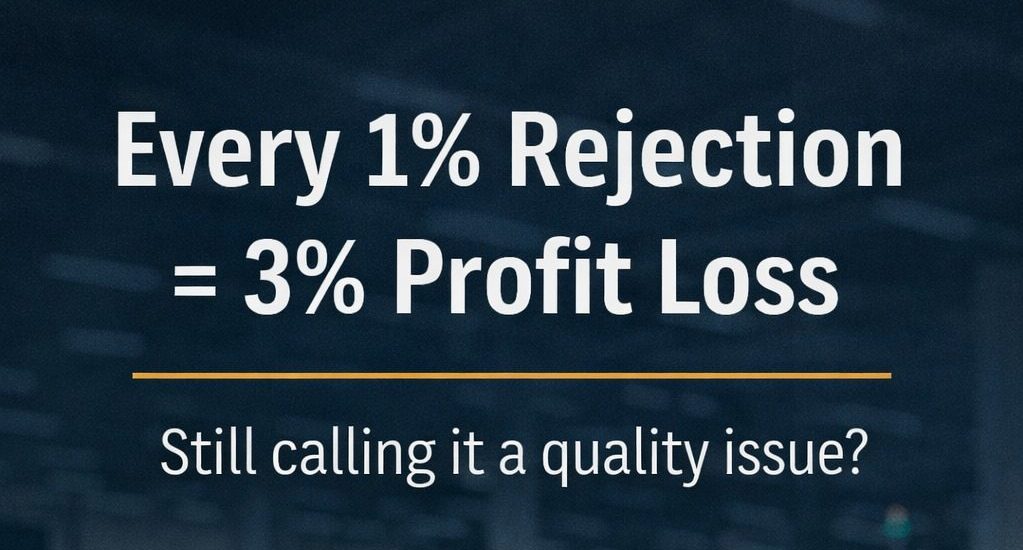
A 1% increase in rejection can lead to a 2–4% reduction in net profit, depending on industry and operating leverage.
This happens because:
- Margins are thin
- Fixed costs remain constant
- Rejection consumes capacity without generating revenue
In high-volume or high-energy industries (foundries, machining, pumps, fabrication), rejection additionally increases energy intensity per good unit, compounding cost pressure.
Why Rejection Spikes During High Production Periods
One of the most consistent patterns across manufacturing environments is:
Rejection is highest during peak production periods.
This is counterintuitive but well documented.
Why This Happens
During high load:
- Supervisory attention is stretched
- Process monitoring weakens
- Parameter discipline relaxes
- Shortcuts become normalized
- Deviation tracking is skipped
Research on production systems shows that process robustness declines under stress unless control mechanisms are deliberately strengthened.
In many factories, the opposite happens.
Inspection vs Process Control: A Fundamental Difference
| Aspect | Inspection | Process Control |
| Nature | Reactive | Preventive |
| Focus | Output | Process |
| Timing | After defect | Before defect |
| Cost impact | Adds cost | Reduces cost |
| Dependency | Human | System-based |
| Sustainability | Low | High |
World-class manufacturing systems invest disproportionately more effort in controlling inputs and conditions than in inspecting outputs.
What Effective Process Control Actually Means
Process control is not theoretical.
It is practical, measurable, and discipline-driven.
-
Parameter Stability
Research in statistical process control (SPC) highlights that stable parameters reduce defect probability exponentially.
Key practices include:
- Defined operating ranges
- Continuous or periodic monitoring
- Immediate response to drift
Awareness of parameters is not enough.
Control requires enforcement.
-
Standard Work
Manufacturing consistency depends heavily on standardization.
Studies in operational excellence show that standard work reduces variability more effectively than experience-based execution, especially in multi-shift environments.
Standard work ensures:
- Repeatability
- Predictability
- Lower dependence on individuals
-
Deviation Tracking and Closure
Deviation tracking converts incidents into learning.
Without structured deviation logs:
- Root causes remain hidden
- Same issues recur
- Inspection becomes repetitive
Process maturity studies consistently identify closed-loop corrective action systems as a key differentiator between high- and low-performing plants.
-
Daily Review Discipline
Frequent review cycles outperform periodic reviews.
Research on management cadence shows that:
- Daily reviews enable early intervention
- Trends are corrected before escalation
- Accountability improves naturally
Monthly reviews are too late to control rejection.
-
Load-Sensitive Control
Processes behave differently under stress.
High-performing systems:
- Tighten controls during peak load
- Reduce allowable variation
- Increase monitoring frequency
This concept is well supported in capacity and reliability engineering literature.
Why Adding More Inspection Often Makes Things Worse
Ironically, excessive inspection can:
- Slow throughput
- Increase WIP
- Mask underlying process issues
- Shift responsibility away from production
- Increase cost without reducing defects
Quality research repeatedly emphasizes:
Quality cannot be inspected into a product. It must be built into the process.
What Manufacturers Can Start Doing Immediately
Without major investment, manufacturers can take meaningful steps:
- Identify top rejection-contributing processes
- Define and lock critical parameters
- Introduce a simple deviation register
- Review rejection daily by shift and process
- Strengthen controls during high-load periods
These steps are grounded in proven process management principles.
Why ACCSOL Focuses on Process Control
ACCSOL Management Services works with manufacturers across Tamil Nadu as business process consultants, focusing on:
- Manufacturing process audits
- Rejection reduction systems
- Production planning discipline
- Inventory and WIP control
- Energy efficiency improvement
- Order-to-cash process alignment
Our philosophy is rooted in process stability before performance improvement.
Inspection is necessary.
But control is essential.
Final Perspective
Inspection provides information.
Control creates results.
If rejection remains high despite strong inspection systems, the issue is not effort — it is process discipline.
Rejection reduces when:
- Processes are stable
- Parameters are controlled
- Deviations are tracked
- Reviews are frequent
- Discipline is consistent
And when rejection reduces, profitability improves naturally.
Request a FREE Profit Leak Assessment
Identify where rejection and process instability are affecting your margins.