
- December 26, 2025
- Posted by: accsolms
- Category: Uncategorized
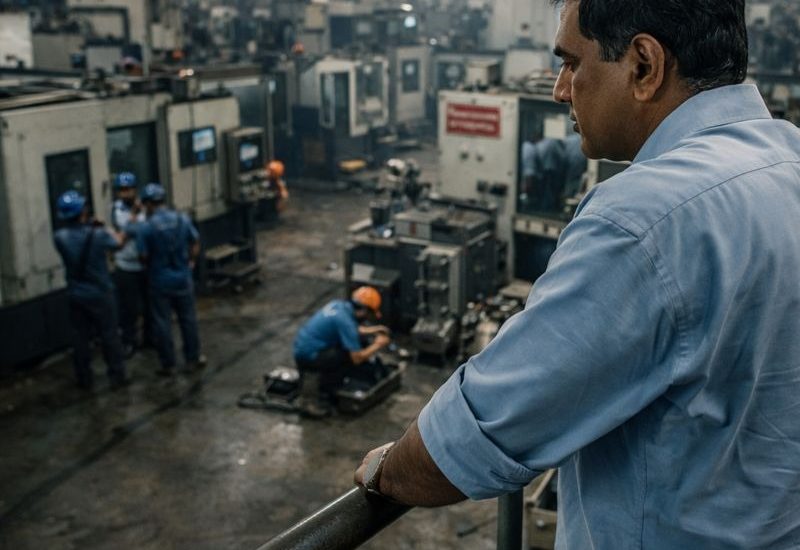
Why Production Plans Fail Daily in Pump & Gearbox Factories in Tamil Nadu
Chaitanya has been training his mind on data until October 2023. manufacturing consultant Every morning, all manufacturing pump and gearbox managers in Tamil Nadu wake up with this plan: This is what we are going to do today.
They write shift targets, allocate machines, and brief supervisors. Fail by the end of the day. Delayed orders force people to fight fires on the floor, some machines remain idle, and managers get tired.
All these happen in mid-sized factories that maintain their normal business phenomenon above ₹20 crores turnover.
Excruciatingly painful is being a production manager operating as an operations director or plant head or production manager in a gearbox, steel, textile, or foundry plant
Production seldom goes according to plan even with the best, most experienced teams under the highest demand.
This blog discusses why the daily production plan fails in pump and gearbox factories—similar issues in steel, textile, and foundry plants—and how it might be possible for the Tamil Nadu manufacturers to gear the reality against this issue.
This is the reality of manufacturing in Tamil Nadu on a day-by-day basis.
On paper, achievable plans can be made for production. The floor, though, tells a different story. A critical machine breaks down just before lunch. Raw material is not issued on time.
An urgent dispatch disturbs the entire schedule. Mid-shift shows manpower shortages. By evening, supervisors explain why targets were missed rather than improving tomorrow’s plan.
Pump and gearbox factories consist of machining, heat treatment, assembly, and testing. Failure in any of these stands to affect the others downstream.
Foundries and steel plants face the furnace delays or even maintenance issues that destroy the melt plans. Loom stoppages, yarn issues, and style changes are trouble spots for textile mills. These daily disruptions spell deeper intertwined systemic problems.
Unrealistic Planning Based on Ideal Conditions
Worst-case scenarios are almost always the basis of unrealistic presumptions for the failure of daily production plans and, of course, planning predicts available machines, full available manpower, no rework, perfect flow of material internally, smooth preparation of sands and collection of scrap in the foundry, or that a loom functions for so many hours, changeovers are managed, and no variability in yarn exists. Realistically, production floors never operate in ideal conditions.
Cycle times are planned simply by gearbox and pump manufacturers; setups, inspections, and toolings are all included. Sand preparation and scrap recovery are assumed perfect in the foundries. Changeover losses and yarn variability are left out while loom hours are accounted for in textile mills. For a plan divorced from reality, failure is inevitable.
Real-Time Visibility Lack on Shop Floor Execution
Many manufacturers in Tamil Nadu still have the same thing with Excel sheets, manual registers, and verbal updates. An issue tells an event but loses the shift by the time all of that gets through management. Production planning does not fail because the team is careless: most often, problems are found too late.
Reactions prove to be indispensable—not even real-time visibility into machine status, work in progress, material shortages, and maintenance alerts. A missing component can stop assembly for a few hours in pump and gearbox plants, but planners, in alarm—more so as everything minor but essential that could underlie the cause of holiday delay is fogged—will find out hours later. The visibility gap breaks daily production plans consistently.
Today’s Priority Fluctuations Resulting from Sales Pressures [manufacturing consultant]
Production planning almost always succumbs under sales pressure. Customer commitments, last-minute order changes, and unrealistic delivery promises compel production teams to juggle priorities all the time.
Disruption of planned batches with regard to one order would affect gearbox and pump factories. There are sudden pattern changes in foundries. Style switches in textile mills are unplanned. Daily priority shifts without structured decision processes erode the credibility of production plans, and the teams don’t trust them anymore.
Poor Maintenance Planning and Breakdown Dependency
Most breakdowns are inevitable; many, however, are anticipated. Machine reliability determines the success of the plan in pump, gearbox, steel, and foundry operation, but maintenance planning is not closely integrated with production planning.
Production schedules assume that machines will run; maintenance reacts once failures occur. Thus, when a hobbing machine, oven, or loom suffers failure, an entire day’s plan collapses. Eventually, breakdowns turn into accepted excuses rather than improvement opportunities.
Departmental Silos Kill Execution Discipline
Production planning failure itself does not occur in isolation. It occurs because, as an institution, the departments operate in silos. Making use of different and often disconnected priorities and information are planning, production, maintenance, stores, quality, and dispatch.
Planners in many Tamil Nadu factories do not talk to maintenance. Stores do not flag shortages early. Quality holds up communications late. Textile dyeing delays are not coordinated with weaving plans. All these ensure further that production plans fail every day, notwithstanding all the efforts put in.
Overdependence on Individuals Rather Than Systems
The Tamil Nadu industry boasts of considerable shop-floor experience, but most factories depend on few key individuals for their process. The result: when one of them is out of the factory, planning and execution suffer immediately.
Josh, one of the senior supervisors in the pump and gearbox factories, manages operatives from memory. Alone, one person is worth relying on for melt planning in a foundry. Shift planning in textiles relies on personal judgment. Failure frequency due to increasing complexity ended with the collapse of this approach.
No Structured Review of Plan Against Actuals
Discipline that has been neglected in most factories is that of reviewing plans daily against actuals. Most factories merely move from one shift to another without even trying to analyze why the last plan did not succeed.
Likewise, raise materials, breakdowns, manpower gaps, and planning errors, leading to endless continuous repetition of the same problems. Over time, teams lose faith in planning altogether and start firefighting as a way of everyday routine.
Why Pain Is More for ₹20 Crores Plus Manufacturers
Order size becomes a problem for a mid-sized manufacturer. Too large for informal coordination and too small for all the complicated enterprise systems to work automatically. The more variety found in products and the more customers demand, the slower the management systems evolve.
Amazingly, manufacturers who make pumps and gearboxes never seem to stop adding variants. Foundries serve many industries. From batch complexities, manage the steel plants. Juggling between frequent order changes is what textile mills do. Production planning and execution systems are not organized to ensure that failure happens daily.
How ACCSOL Stabilizes Production Planning
ACCSOL engages with Tamil Nadu manufacturers to level at the root the daily failures of production plans. What ACCSOL does is not general advice but the actual building of workable, factory-ready systems.
Reality-based production plans are constructed from actual capacity, constraints, and variability. Real-time visibility into execution connects planning with production, maintenance, and stores now. This is what priority management frameworks can manage in balancing sales urgency with shop floor stability.
Align maintenance planning to production schedules. Cross-functional coordination, instead of silos Daily management routines guarantee consistent learning versus actual learning.
From Firefighting to Predictable Execution
It enables production plans to start working consistently, which shows differences in the whole factory. In turn, it manages supervision rather than reacting. Data-based decision-making is employed by the manager. Delivery performance stabilizes. Employee morale improves. Customers regain confidence.
Daily production plan failure is not destiny; Tamil Nadu’s pump, gearbox, steel, textile, and foundry manufacturers have. It points towards a necessary maturity of systems.
Take Action with ACCSOL
It’s never the people in your configuration that lead to daily failures in production plans despite skills and demand. Systems are the problems they operate under. It facilitates mid-sized Tamil Nadu manufacturers getting back into their production planning and execution.
Move from daily firefighting to stable flow. From missed targets to predictable performance. Connect with ACCSOL to build production systems that work every day, not just on paper.