
- November 4, 2025
- Posted by: accsolms
- Category: Uncategorized
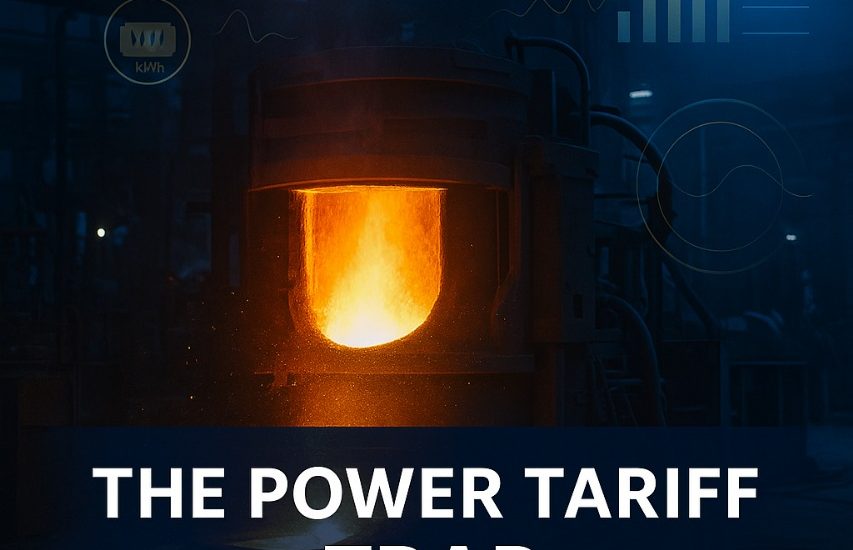
The Power Tariff Trap: Managing Energy Costs in Tamil Nadu Foundries
The foundry has the top consultants in Coimbatore near me. Tamil Nadu feeds into a vast industrial chain from automotive to pump casings to heavy engineering castings. On one hand, while production goes on day and night, on the other, the electric meter has been rotating with untold speed.
For most foundries today, power has moved from being an operational expense to being the biggest one in determining profit or loss. Rising tariffs, changing loads, and faulty operation of the furnace silently eat away margins that are already eroded any month.
This post looks into why even the largest energy costs are make-or-break issues for Tamil Nadu foundry producers today and how disciplined practices using data can change the case.
The Energy Challenge In Numbers [top management consultants in coimbatore]
Electricity contributes 25% to 35% of the total production cost for a foundry. Despite being one of the major industrial states in India, Tamil Nadu has some of the highest tariffs for power in India; demand charges, penalties, and inconsistent load factors actually raise costs per tonne over projections.
Foundries operating induction furnaces, air compressors, dust collectors, and heat-treatment units depend on uninterrupted power supply; still, many also rely on manual control and operator intuition instead of measurement and analysis. Every unexpected incident—whether melting for 10 minutes more than needed or delaying pouring or using the wrong charge mix—becomes a greater energy loss with time.
Why Do Energy Losses Go Unnoticed?
Energy wastage—more subtle than any individual glaring inefficiency—somehow hides behind routine inefficiencies that keep happening every day:
1. Unstandardized Furnace Operation
Operators follow different procedures in an uncontrolled manner. Because cycle time and temperature are not strictly adhered to, furnaces continue to consume extra kWh per heat.
2. Hollow Power Factor and Idle Load:
Motors, compressors, and auxiliary equipment are usually running at a sub-optimal load or staying on even at standby during breaks.
3. Random Charge Mixes
Operating with different types of scrap, unmeasured returns, and metal ratios that add a lack of optimization tends to alter behavior to melt and draw energy.
4. Knee-Jerk Maintenance
Equipment is attended to only on breakdown. Furnace coil efficiency response gradually deteriorates, and thus energy consumption rises before this is realized.
5. Absence of Real-Time Monitoring
Most foundries still take measurements from EB bills, using manual control of energy data. Hence, loss is already chronic once described.
Power Cost:
The Realistic Meaning Let us give some meaning to this. An average foundry with a 1-ton furnace running 3 heats per shift may use approximately 650–700 kWh per heat.
At the rate of ₹10 per unit, it amounts to ₹7,000 per heat, that is, ₹21,000 per shift.
Suppose even 5% of that energy is lost to something as simple as over-melting or pounding idle cycles—that is ₹1,000 down per shift, totalling ₹3 lakh a year. Multiply by the number of furnaces and years—that is absolutely big.
The kicker?
Most foundries would not notice such leakage because there is no way to monitor it on a daily basis. The malaise is practically there for everybody with an inquiring mind to see.
Step 1: Standardize Furnace Operations
Efficiency starts here with discipline during the melting. Standard operating procedure parameters for:
• Charge weight and composition
• Melt start and end temperature
• Holding time before pouring
• Target kWh per ton
A standard cycle card should be fixed on each furnace where all management expects operators to have access. This sets clear expectations and random variation between shifts.
Pro Tip: Daily monitoring of energy per ton with any deviation > 5% should lead to an immediate review of both process and equipment.
Step 2: Build Visibility through Data top consultants in coimbatore near me
What can’t be seen can’t be controlled.
The next step is to prepare real pertinent visibility of energy consumption—location-wise, time-wise, and reason-wise.
Install Smart Meters: Major equipment needs to be fitted with logging data automatically connected to energy meters: furnaces, compressors, and cooling systems.
Develop Dashboard: Monitor kWh/heat, shift, and operator.
Detect patterns: spikes or dips.
Set Alerts: Automatic thresholds trigger alarming standards against excessive consumption.
Shift Comparison: Research which operator or batch is power efficient.
Even this simple visualization can turn the management model for such operations upside down for the supervisors: decisions are going to be rather evidence-based, not assumption-based.
Step 3: Improve Power Factor and Load Management
Like all the states in India, TNEB also penalizes poor power factors as well as maximum demand violations. Viable savings in foundries could be achieved by,
Automatic power factor correction (APFC) installation with a maintained power factor of not below 0.98
Loading the equipment in sequence to avoid sudden peaks of demand
Running heavy loads like compressors during off-peak hours
Simple demand management normally could yield about 2%-3% pure savings through scheduling and balancing the system.
Step 4: Optimize Furnace Charge Mix
The time-dependent energy use is also dependent on the actual contents of the furnace.
Uniform pre-weight charge mixes have proportions of pig iron, returns, and scrap controlled.
Don’t overspend with returns; they are cheaper, usually have longer melt times, and have more temperature requirements.
Monitor slag volume and metallic yield; those are energy performance indicators.
Small experiments and tuning of charge mix can help foundries adjust the power consumption per ton while ensuring metallurgical quality.
Step 5: Move from Reactive to Predictive Maintenance
Furnace coils, hydraulic systems, and power cables deteriorate gradually. By the time deterioration becomes apparent, teams usually miss the warning signs—hence
longer melting times or fluctuating temperature.
The predictive maintenance programs identify:
Temperature monitoring of coils by sensors,
Motors and their vibration,
Applied maintenance logs versus applied performance trends.
This cleans up for approaching service prior to actual inefficiencies developing and reduces the downtime with it, the invisible power loss.
Step 6: top consultants in coimbatore near me Energy Cost as a KPI
Treating “Energy Cost per Ton” with as much seriousness as “Rejection Rate” or “Production Yield.”
It is put under review each day.
When management makes it visible, then teams naturally start optimizing around it.
Because of these incremental shifts, culture builds over time into each individual understanding of power = profit, from operator to accountant.
Hidden Benefits of Energy Discipline
Energy management is not just about saving rupees from energy conservation. It releases several other benefits:
Better casting quality:
The consistent melt temperature gives consistent metallurgical properties.
The lifespan of equipment:
Less overheating and stress on coils.
Lower footprint of carbon emission:
Less energy consumption means cleaner operations.
Improved cost forecasting: Stable kWh/ton will help stabilize pricing and bidding accuracy.
Foundries with real mastery over energy management will obtain a cutting edge on cost as well as on superior quality.
From Data to Decision—the Smarter Foundry Shift
Modern foundries are adopting simple, smart systems that take energy and production data and convert them into actionable insights.
Theoretically speaking, one can say that this is all about the dashboard:
Shows your cost per ton live
Indicates furnaces which deviate from guide norms
Predictive maintenance actions before breakdown
Automatically provides weekly summaries of performance trend
Such instruments are certainly not just for the largest of corporations. Savings can be made even through compact, budget-friendly systems that pay the cost of implementation within months for small- and medium-scale foundries in Tamil Nadu.
Less waste, more control, higher profit.
The ACCSOL Perspective [top consultants in coimbatore near me]
In our experience at ACCSOL Management Services, this pattern has become clear:
The increased costs of energy are driven not only by external parameters but also by internal hidden inefficiencies.
Foundries that measure every kWh, every minute, and every cycle discover savings hiding in their routine.
Our process specialists help manufacturers standardize furnace operation, digitize visibility to costs, and build a data-management dashboard that will introduce common sense into faster and more profitable decision-making.
Conclusion—Energy Efficiency translates into Profit Efficiency
New furnaces won’t lower costs for foundries. What they need in Tamil Nadu is a better way of controlling their current furnaces. The control could be exercised by:
Standardized Operations
Real-time Monitoring
Smart Maintenance
Aim on data for decision-making
You cannot escape the “power tariff trap” by negotiation; it’s avoidance by fine precision.
If your foundry struggles with wildly variable energy bills or an increasing cost per ton, then it is time to act.
Author Bio
Binsy Bose is the founder of Accsol Management Services Pvt. Ltd. (Accsolms). With over 15 years of experience, Binsy has helped manufacturers across Tamil Nadu and neighboring states identify hidden profit leaks and achieve operational excellence.
Visit us at www.accsolms.com to learn more or book a free consultation today.