
- October 15, 2025
- Posted by: accsolms
- Category: Uncategorized
How Indian Manufacturers Are Losing Money Unnoticeably
India’s manufacturing sector is on a strong growth trajectory, contributing significantly to exports, employment, and industrial development.
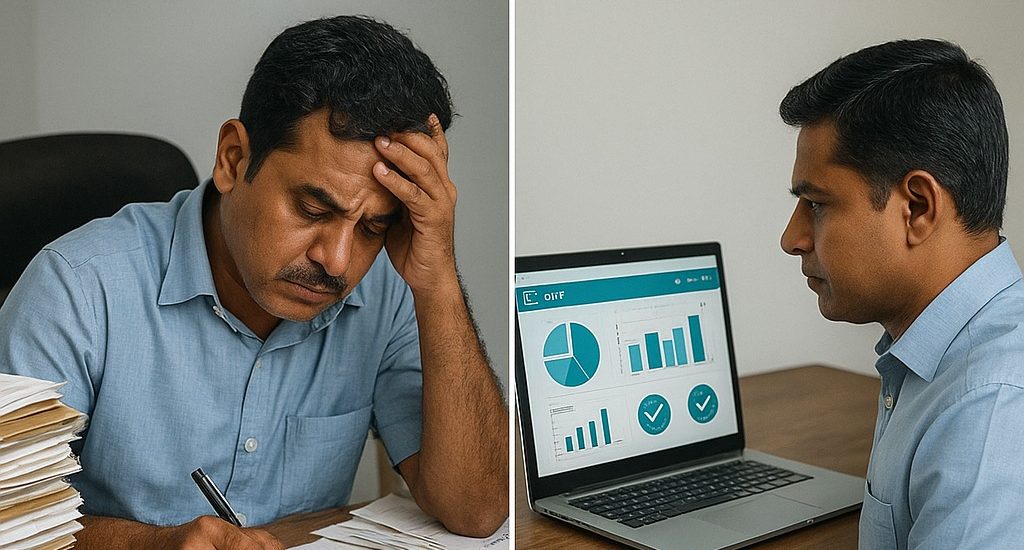
Beneath the surface, many manufacturers are unknowingly bleeding money
through hidden profit leakages that often remain invisible until margins start eroding.
These losses don’t always appear clearly on balance sheets, but their cumulative impact weakens profitability over time.
Hidden inventory costs, unplanned downtime, poor costing practices, and manual errors are some of the silent killers.
The good news? With the right systems, processes, and expert guidance, most of these leakages can be identified and plugged.
This blog highlights the seven main reasons Indian manufacturers lose money.
shares a 90-day profit recovery checklist, and explains how consulting experts like those in Tamil Nadu, India, can help manufacturers recover hidden profits.
why Incorrect Product Costing and Pricing
One of the biggest drains on profits is inaccurate costing. Many factories calculate costs based only on
direct labor and raw materials, neglecting overheads such as energy, maintenance, quality rework, and indirect labor.
This leads to underpricing, eroding margins. A product may appear profitable on paper but actually cost more than it earns.
How to Fix:
Implement Activity-Based Costing (ABC) to capture hidden overheads.
Review product profitability monthly.
Eliminate or reprice low-margin products.
Infographic Idea: Iceberg model—visible costs above water (materials, labor) and hidden costs below water (overheads, scrap, energy, downtime).
Inventory That Eats Cash
Excess raw materials and finished goods may look impressive but tie up working capital.
Carrying costs like storage, insurance, pilferage, and obsolescence silently reduce profits.
Inefficient projections often lead to unplanned production, excess raw material stocks, or duplicate SKUs—all costly mistakes.
Adopt Just-In-Time (JIT) inventory management.
Conduct ABC analysis to identify slow-moving and obsolete stock.
Perform regular cycle counting to prevent dead stock.
Infographic Idea: Warehouse illustration labeled “Cash Frozen in Inventory.”
Downtime That Goes Unnoticed
Many manufacturers underestimate machine downtime.
While big breakdowns get attention, small stoppages, slow setups, and idle times often go unrecorded—adding up to hours of lost productivity daily.
For example, a 15-minute loss per shift equals over 90 hours per year—enough to produce thousands of extra units.
How to Fix:
Track Overall Equipment Effectiveness (OEE).
Implement Total Productive Maintenance (TPM) practices.
Train operators to record micro-stoppages.
Infographic Idea: Pie chart of machine time split into “Running,” “Minor Stops,” “Breakdowns,” and “Idle.
Rejects, Rework, and Scrap Poor quality control is another silent profit leak.
Rejects and rework waste raw materials, labor, and machine time.
Many factories treat scrap as “normal” without realizing its impact on margins.
At a 3% rejection rate on an order of 10,000 units, 300 lost products equate to thousands of rupees wasted.
How to Fix:
Calculate the Cost of Poor Quality (COPQ) per SKU.
Introduce in-process quality checks.
Train workers in first-time-right practices.
Infographic Idea: Process flow showing “Material → Production → Scrap = Money Loss.”
5. Supplier and Procurement Leakages
Inefficient procurement increases costs silently. Sourcing from too many small vendors leads to poor quality, high prices, and emergency purchases.
Manufacturers often miss opportunities to negotiate long-term contracts or leverage bulk buying to reduce expenses.
How to Fix:
Consolidate suppliers for better deals.
Negotiate annual contracts for bulk discounts.
Conduct regular audits of supplier performance.
Infographic Idea: Funnel graphic: multiple suppliers at the top, cost leakage dripping at the bottom.
6. High Energy and Utility Costs
Energy costs are a recurring but often overlooked expense. Idle machines, outdated motors, and poor power factor correction quietly inflate electricity bills.
In energy-intensive industries, even a 5% reduction in power use can save lakhs annually.
How to Fix:
Schedule energy audits.
Install power factor correction equipment.
Apply lean manufacturing to reduce idle machine time.
Infographic Idea: Light bulb graphic captioned “Energy Waste = Money Waste.”
7. Manual Processes and Human Errors
Manual processes in payroll, billing, procurement, and production planning are error-prone. Mistakes result in time lags, double payments, and lost customer trust.
Automate routine tasks like invoicing and approvals.
Infographic Idea: Before vs. After graphic—Manual (Errors) vs. Digital (Accuracy).
Quick Profit Recovery Checklist (First 90 Days)
A step-by-step plan to recover hidden profits quickly:
Develop a profitability report at the product level; flag low-margin products.
Liquidate obsolete stock to free up working capital.
Track downtime on OEE and fix the top three root causes.
Negotiate better supplier terms and consolidate vendors.
Track scrap and rework costs; start reducing them.
Conduct energy audits to cut utility expenses.
Begin digitizing manual processes with simple ERP modules.
Infographic Idea: Checklist infographic with tick marks.
Why Most Manufacturers Miss These Losses
Sales over efficiency:
Chasing orders without analyzing cost leaks.
Data deficient:
Invisible losses remain hidden without metrics.
Cultural acceptance:
Waste is seen as “normal” by teams.
Limited perspective:
External experts see what internal teams overlook.
This is why fresh ideas and proven systems from external consultants help manufacturers plug hidden leaks faster
Frequently Asked Questions (FAQ)
Q1. What is the largest hidden loss in Indian manufacturing?
Inaccurate product costing. Many manufacturers undervalue their products by ignoring overhead costs, cutting overall profitability.
Q2. How soon can hidden profits be retrieved?
Quick wins like supplier renegotiations or pricing corrections can show results in 30–60 days. Larger process changes (like downtime reduction or digital operations) may take 3–6 months.
Q3. Do small manufacturers need ERP systems?
Not necessarily. Start with lightweight ERP modules or digital tools for costing, inventory, and billing instead of heavy, expensive systems.
Q4. Why hire a consultant instead of fixing issues internally?
External consultants bring an objective viewpoint, spot issues internal teams miss, and provide a clear roadmap to recover profits quickly.
Conclusion
Indian manufacturers are losing money in ways they don’t even realize—hidden costs,
untracked downtimes, rejects, inefficient procurement, and manual errors. These losses are silent but real.
By adopting data-driven decisions, preventive maintenance, digital systems,
and external audits, manufacturers can unlock hidden profits, strengthen margins, and achieve long-term sustainability.
If you’re a manufacturer struggling with hidden costs, connect With over 15 years of experience, our team helps businesses unearth leakages, improve efficiency, and boost profits.
Author Bio
Binsy Bose is the founder of Accsol Management Services Pvt. Ltd. (Accsolms). With over 15 years of experience, Binsy has helped manufacturers across Tamil Nadu and neighboring states identify hidden profit leaks and achieve operational excellence.